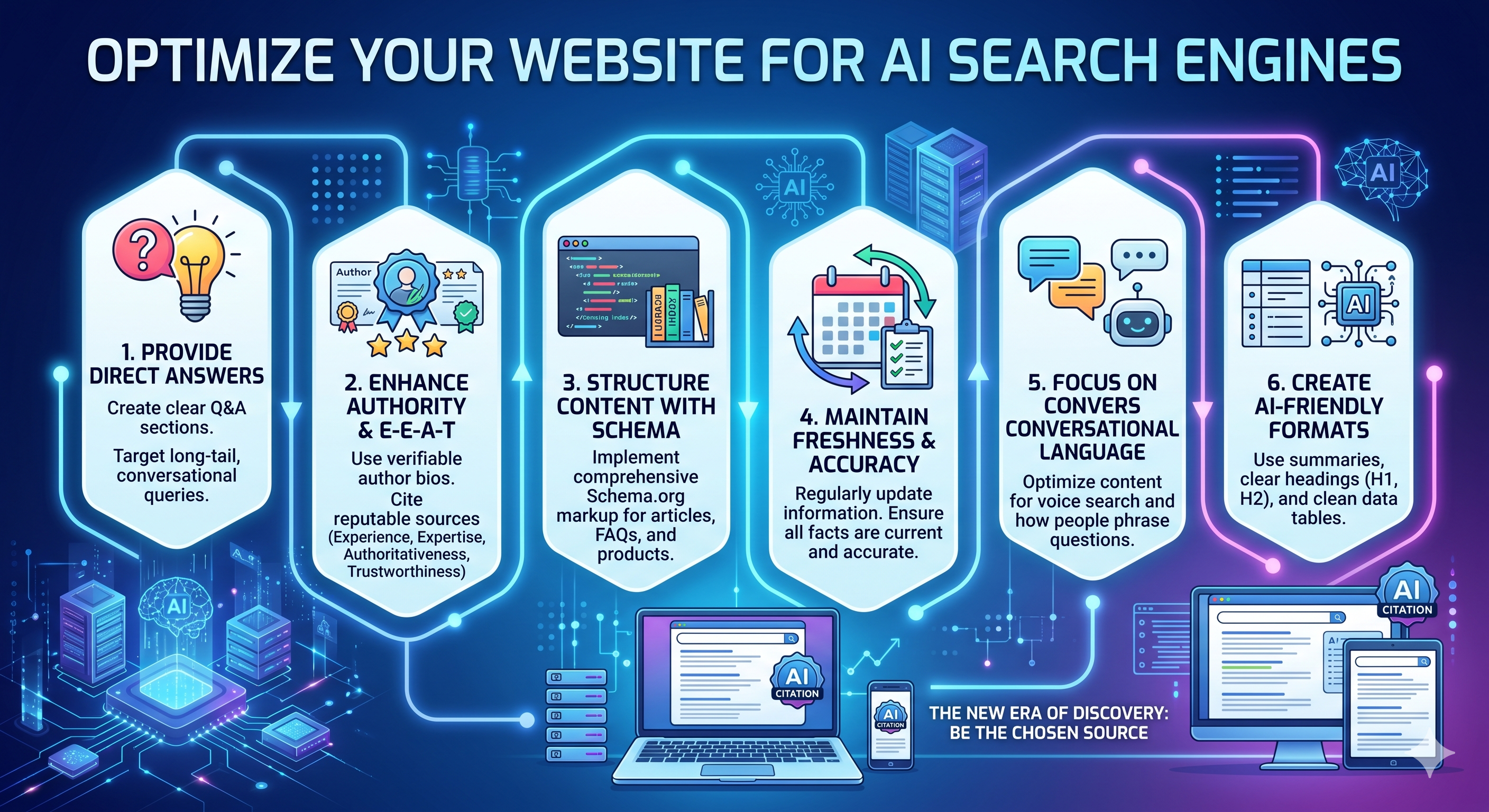
How to Optimize Your Website for AI Search Engines
Search looks really different these days for website.
Not that long ago,people tossed a few words into Google, skimmed the page, and clicked on a site. Now, folks are asking questions straight to tools like ChatGPT, Gemini, Perplexity, and Google’s AI Overviews. Instead of showing you a bunch of websites, these platforms usually give you direct answers in seconds.
So, if you’re a business owner, you’ve got a new challenge. If your site isn’t put together in a way that makes sense to these AI-powered search tools, you’re risking your visibility, your traffic, and potential customers.
Here’s the bright side: you don’t have to throw out your whole SEO playbook. You just need to lean harder into helpful content, a clear site structure, and a good experience for your visitors.
Let’s dig into simple, practical ways to get your site showing up in AI-driven search results—on top of everything you’re already doing for traditional SEO.
What Are AI Search Engines?
AI search engines use artificial intelligence to make sense of questions, scan tons of sources, and give people direct answers.
Some big players:
- ChatGPT Search
- Google AI Overviews
- Gemini
- Perplexity AI
- Microsoft Copilot
Instead of tossing lists of links at you, these tools try to hand you a solid answer right away. But to do that, they’re picky. They look for well-built, trustworthy, in-depth content.
So, ranking for keywords isn’t enough anymore. Your website needs to build real authority and be a source they can trust.
Why Do Businesses Need to Care?
Search habits are shifting fast.
People are moving away from one-word searches—and instead, they’re typing full questions. AI search is only picking up speed, and businesses that move fast stand to win.
By adapting to AI search:
- Your brand shows up earlier and in more places—sometimes even if folks never land directly on your website.
- You build trust and authority by offering solid, accurate info that AIs reference.
- The leads you get are often further down the funnel; they’ve done their homework.
- And honestly, a lot of companies haven’t noticed this trend yet. You can get ahead.
Start With What People Actually Want
Lots of people treat SEO like some keyword game.
But at the heart of it, good content means you understand what your audience cares about.
Before you write, ask:
- What problem is my reader trying to solve?
- What questions do they really have?
- What info will actually help them?
AI search engines look for content that gives clear, useful answers. The more you focus on real people (not tricks or shortcuts), the more the AIs will pick up your stuff.
Answer Questions—Don’t Dance Around Them
More and more, people type or speak full questions when using AI search.
For example, instead of searching “AI SEO,” they’re more likely to ask, “How can I optimize my website for AI search engines?”
So, match your content to what people are actually asking. Use headings like:
- How Do AI Search Engines Work?
- What Is Answer Engine Optimization?
- Why Is AI Search Important for Businesses?
- How Can Small Businesses Improve Their AI Visibility?
Just get straight to the answer. That’s what people want—and what AI wants to use.
Go Deeper Than Keywords: Focus on Topics
Search engines have gotten smarter.
Don’t cram a single keyword in over and over. Build content that covers a whole topic, start to finish. If you’re writing about AI Search Optimization, talk about:
- Answer Engine Optimization (AEO)
- Semantic SEO
- Structured Data
- User Intent
- Website Performance
- Content Quality
- E-E-A-T Principles
This gives your content context and positions your site as an authority. Search engines understand bigger pictures now.
Get Your Website Organized
People (and search engines) need to find things easily.
Small tweaks can make a big difference:
- Use clear, logical headings.
- Set up your navigation so it’s quick and easy to find key info.
- Link related pages together inside your site.
- Keep your URLs short and clear.
A simple, tidy website is easier for AIs (and people) to make sense of.
Add Schema Markup
Schema markup is like leaving helpful notes for search engines.
You’re telling them, “Hey, this is a review,” or “This part is for FAQs.” It gives search engines helpful clues about your content.
Some useful schema types:
- FAQ Schema
- Article Schema
- Organization Schema
- Local Business Schema
- Review Schema
People never see this code, but it helps AIs understand your site better.
Show You Actually Know Your Stuff
AIs favor sources they trust.
Don’t just post generic tips. Share real stories and proof:
- Case studies
- Client results
- Industry insight
- Concrete examples
- Firsthand experiences
If your agency helped a client grow leads, walk through what you did—step by step. Real-life detail sticks out and gets picked up by AI more than fluffy, recycled info.
Make Sure Your Site Works on Phones
Most folks browse on their phones. If your site’s a pain to use on mobile, people leave fast.
Check that your site:
- Loads quickly
- Looks good on any screen size
- Uses readable fonts
- Has buttons you can actually tap
- Just feels smooth to use
Good mobile design matters both for traditional SEO and AI-driven search.
Speed Up Your Pages
Nobody waits for a slow site, and Google’s bots don’t either.
To get faster:
- Compress images so they’re smaller
- Ditch unnecessary plugins or scripts
- Use good web hosting
- Turn on caching
- Clean up your code
A little speed boost goes a long way for both users and search bots.
Add Helpful FAQ Sections
People love to ask questions—and so do AI tools.
FAQ sections are great because they map perfectly to how people and AIs interact. Consider questions your audience really wants answered.
For example:
What is AI Search Optimization?
It’s the process of making your website easier for AI-powered search engines to understand, trust, and reference.
Is AI Search Replacing Traditional SEO?
Nope. Classic SEO still matters, but you can’t ignore AI search either.
How Can Businesses Appear in AI Search Results?
Create high-quality content, organize your site, show authority, and put user intent first.
FAQs often get picked up directly by AI bots.
Strengthen Your Brand
AI tools don’t just look at your website; they scan your whole online presence.
Help them trust your business by:
- Staying active on social media
- Encouraging happy customers to leave reviews
- Getting featured on industry sites
- Publishing expert content
- Making sure your business info matches everywhere
The more solid your brand looks online, the easier it is for AI and search engines to consider you trustworthy.
Play the Long Game
You won’t become an authority overnight.
The sites that win with AI search are usually the ones that help people consistently, over time.
Instead of chasing shiny tricks, focus on:
- Publishing quality content regularly
- Actually solving real customer problems
- Always improving your site and user experience
- Building genuine credibility in your field
This was always good SEO—and it matters even more now.
Wrapping Up
AI search is changing how we all find information, but the basics still win.
Websites that give clear answers, honest insights, and a great user experience get noticed by both traditional and AI-powered search.
Don’t just chase algorithms. Write and create for people. Help your audience, answer their questions, and show what you know.
Stick with that, and your site won’t just do well in AI search—it’ll become a trusted resource people actually use and share.